“The real enemy is the man who tries to mold the human spirit so that it will not dare to spread its wings.” – Abraham Flexner
The Alpinist, a Netflix documentary, shows Marc Andre LeClerc doing outrageous alpine mixed-climbing (ice and rock) with no rope. If you have the pleasure of watching it, you will be white-knuckling your arm rests and wiping the sweat from your forehead. Watching him climb is one of the few legal ways to have a religious experience.
Do I have your attention?
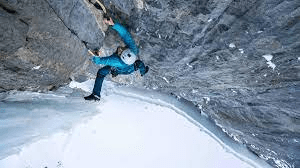
The documentary goes through Marc Andre’s life, how he became a climber, and why he likes to dangle on the side of a mountain by the pick of an ice ax. Unfortunately, about ½ way through the film, the morality of free soloing comes into question. Every commentator has the same thing to say. You probably heard all about free soloing from Alex Honnold’s ascent of Yosemite, so I will not bore you with the details. We get it, free soloing is dangerous and selfish. Trite. Boring. This is something we all understand.
Not so fast. It isn’t clear to me that any of these free-solo naysayers have spent much time really thinking about the implication of the free solo. Is it really insane and immoral? Quite the contrary.
Free Solo as the Ultimate Experience
Marc Andre LeClerc was a man of extremes in all facets of life – searching for the ultimate adventure in whatever way he saw fit. Climbing was his go to medium, but it was shown in the film that when all his friends wanted to take a half tab of acid and sit on the couch, he would want to “take 6 tabs of acid and disappear for a couple of days.” He adored the outdoors, and typically sought the ultimate experience of intense flow state and complete engagement though free solo alpine climbing (unconventional, I’ll give you that).
You’ve probably felt something like (but not quite) the ultimate experience before.
- You start working on something at 7:00pm and all of the sudden you check the clock and it is 1:30am. You look back on the time you spent “working” and smile.
- You are walking down the street with someone you may have feelings for. You reach for their hand. You feel it squeeze back.
I wish for you, dear reader, to be lucky enough to experience moments like these. They are the essence of our absurd being. They are all we have.
The ultimate experience is what I am defining as what one pursues as their highest form of aliveness. Yours may be IPO’ing your startup, or watching your children graduate high school, climbing Mt Everest, qualifying for the Boston Marathon, or even just laying on the couch without being accompanied by crippling anxiety.
The ultimate experience is something unique to you. Whether you can choose what your mind sees as the ultimate experience is up for debate, but it should be clear to you, dear reader, that the pursuit of the ultimate experience is a birthright. After all, you would do everything you could to get your children to this state, wouldn’t you?
Marc Andre’s ultimate experience was free soloing alpine routes. John Doe’s is his children. Difference in danger? Absolutely. Difference in essence? None.
Unanimously Rejected
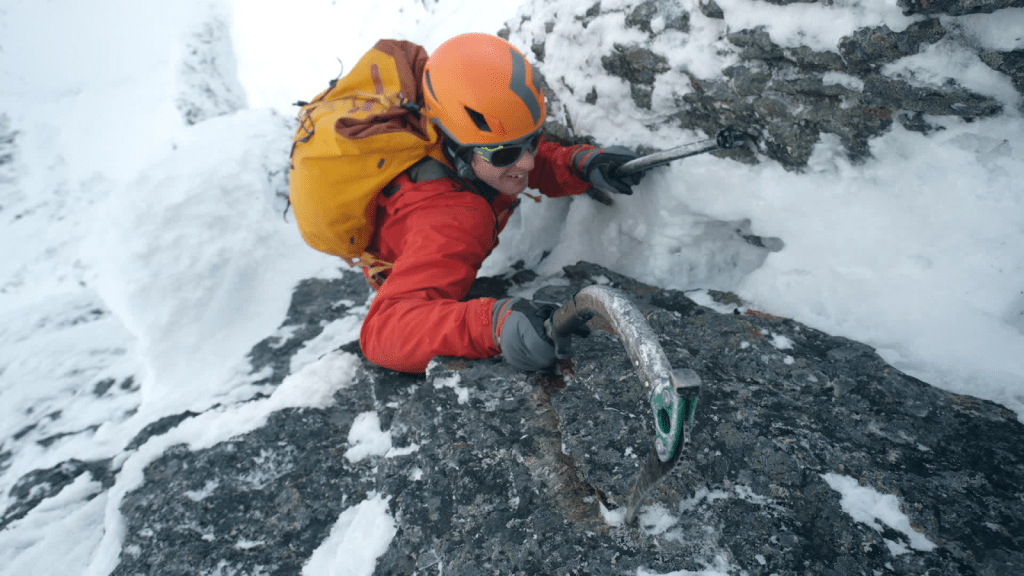
Other climbers in the film were saying how dangerous and possibly unethical free soloing is, alleging that the sport (if you want to call it that) is “such a contradiction.” I think they say these things because it seems like what they should say. On the surface, it seems like free soloing is something that can be condemned, or judged, without much risk of controversy – like condemning murder. The commentators in the film never had someone question their statements – so let me do it for them now.
Why is it unethical? Don’t you want to keep watching him (not necessarily Marc Andre) free solo? Are you scared he won’t be free soloing for much longer? Will you just miss drinking with him on weekends? Do you just want to keep hanging out with him? What if he weren’t free soloing? Would he still be the same person that you admire and try to protect? How would you feel knowing that you are contributing to the suppression of the human spirit?
Protection of Adults Is a Pseudo-Virtue
Telling adults to “be careful” or to discourage them from doing something that you or the general public would see as dangerous or damaging is a shallow pseudo-virtue. It is simply a way to gain easy (i.e meaningless) brownie points amongst your peers. A fully formed, mature, able adult does not need you to tell them to be careful when driving a car, or climbing a mountain. They are fully aware of the danger of their situation, they are choosing to take the risk. Informing them is only a way to signal your care for them, or, put more cynically, your disapproval of the activity. It is nothing more than a cheap signal.
Marc Andre LeClerc is a great case study on this. You see him dangling from the edge of an ice ax and you wonder if he knows that if he falls, he dies. He graciously answers this question for us in the documentary. “I know it’s dangerous.” See? He knows. You don’t need to tell him.
A competent adult does not need you to tell them to be careful. What the adult needs is for you, oh, oedipal mother, to back off.
Restriction of Adults Is Criminal
I can understand not wanting someone you love to free-solo. It is a natural, selfishly minded reaction – you want this person in your life and you worry that free-soloing will take them out. However, this is not a valid reason to prevent this person from free-soloing. They are simply pursuing what is their birthright. Free-soloing is a pursuit that I would classify as “fair play.”
In a nutshell, to play fairly implies that the pursuit of your ultimate experience does not infringe on anyone else’s pursuit of an ultimate experience.
“Your right to swing your fist ends where my nose begins.”
Isolated Selfishness Is a Virtue, Pervasive Selfishness a Sin
There is no such thing as a selfless act. I expanded upon this in another article in this publication, so I will not go too deep into it here. The general idea is that humans are utility maximizing agents, and we will pick the action that maximizes our expected utility after accounting for all of our weaknesses, shortcomings, strengths, insecurities, and courage.
You aren’t selfless for calling your mother on the weekends. You like to call your mother on the weekends, and you would feel terrible if you didn’t. Your conscience is in control – it will punish you if you don’t do the “right” thing (if you are in prison this is likely not the case for you). There are many more examples that may be brought up as examples of allegedly selfless acts, but none of them hold up to scrutiny. You saved your brother from a burning building? Good for you, but you just couldn’t bear the thought of your brother dead, leaving behind his children and wife. You thought it would be beneficial to save him, so you did.
The point is that every action you take is in your own self interest. In this sense, everyone (quite literally) is acting selfishly all the time. For example, I “selfishly” want to see my friends succeed. I “selfishly” want to have strong and healthy relationships. I “selfishly” want to make other people happy. I can do all of this and people will call me a selfless, well adjusted member of society.
The only time we care to point someone else out as truly selfish is when their self-interest doesn’t align with their community. A psychopath will selfishly cheat in poker. He will selfishly rob you in the street. Yet, he will be labeled selfish and be sent to prison. Sure, he is rightfully sent to prison, but calling him selfish is just like calling him a human… we already knew that.
In these two scenarios (my selfish choices vs the psychopaths selfish choices) only the psychopath will be called selfish by broader society, even though we were both acting equally in our self interest. I just happen to care about my friends and community and want them to accept and welcome me. My socialization, or my desire to be a part of a community, is what distinguishes my selfishness from the psychopath’s selfishness.
Selfishness can be divided into two categories, isolated and pervasive. Selfishness is only virtuous when it is not infringing on the rights of others (their ability to selfishly pursue their ultimate experience or actualization). This is what I will define as isolated selfishness. In this framework, it is not fair play to restrict someone else’s path towards the ultimate experience, no matter how much you believe it will lead to your own ultimate experience. So, if you believe your ultimate experience is a murderous rampage, sorry, you are out of luck, as that is not classified as fair play. I am free to act selfishly so long as I am not disturbing anyone else’s selfish acts.
Pervasive selfishness, on the other hand, is what most people mean when they call someone selfish. Pervasive selfishness would be when my self interest contradicts yours. For example, I want to make a lot of money in poker, so I just cheat and steal your money. The problem is that you also want to make a lot of money in poker, and my divisive actions went against your interests. I’m sure you, dear reader, can come up with many more examples of pervasive selfishness.
Isolated Selfishness Examples
- Listening to a song you enjoy in your apartment with headphones
- Cooking your favorite meal
- Talking to your mother on the phone
- Complimenting your girlfriend
- Donating to a charity
- Adopting a rescue dog
- Saving a baby from a burning building
Pervasive Selfishness Examples
- Most illegal things
- Punching your brother in the face because you want to see what it would be like
- Randomly hitting someone with your car on purpose
- Bullying
- Starting a coup d’etat just to see if you have the ability to become a dictator
- Not using a turn signal
I want to make a point here that selfishness does not contradict decency. Selfish DOES NOT MEAN against the interests of others. If we were only interested in doing things against the interest of others we would have never built communities – we would have gone the way of the neanderthals. Selfish as I describe it doesn’t really mean anything, as it is an all encompassing classification. Everything you do is selfish, e v e r y t h i n g.
You get the point… moving on.
Free Soloing Is Fair Play
Let’s say I don’t want you to free-solo because I care about you. I don’t want you to die, and I want to see you grow up and have a family. These are valid concerns, as any reasonable person would agree. However, once it is established that free-soloing really is your method of self-actualization, or your ultimate experience, then I am now obligated to put my personal feelings aside and even encourage you on your heroic journey. To restrict your journey towards the ultimate experience is to stifle the development of human potential – this is criminal. I have no right, and I ought to have no desire, to keep you from the ultimate experience, or self-actualization. No matter how much I love you, or how much I like hanging out with you, and yes, even if I raised you, I still have no right to restrict your heroic pursuit, lest I be labeled as pervasively selfish.
The Ideal World, According to this Philosophy
Ideally, you, and all of your community, are pursuing your selfish desires together. You selfishly want others to succeed. You selfishly comfort each other when things are hard. You encourage the pursuit of actualization for all those who choose to engage in fair play.
The ideal world will have people who are strong enough to know when their personal desires are infringing on someone else’s actualization, and they adjust accordingly. In the ideal world, Marc Andre is revered for climbing alpine faces solo, not slandered.
The ideal world has everyone pursuing their passion, their actualization, their ultimate experience without the negative, draining, zombifying chatter of “are you really going to do that?” or “that’s dangerous.”
Exceptions to the Rule – Limits of Actualization
In most situations, you can always be pursuing your actualization, as you are unlikely to find actualization in the same way Marc Andre found it. However, I still must classify when it would no longer be fair play for Marc Andre to free-solo alpine faces.
Excessively dangerous (whatever that means) pursuits of actualization are no longer fair play once a person adopts responsibility – whether it be voluntary or involuntary. Let’s say Marc Andre were to have a child that he was responsible for feeding and raising. He is no longer, by the rules of fair play, allowed to dangle by the edge of an ice ax with no rope. Sorry Marc Andre, but your son was brought into this world because of you, and you are obligated to care for him and support your partner in raising him. I hope you don’t see this as controversial. In my first experience mountaineering, my climbing buddies and I accidentally stumbled upon a seemingly bottomless crevasse. One of the climbers saw this and decided to descend, saying “I have a daughter, I don’t need to take any unnecessary risk.” Fair play – exactly what a decent father ought to do.
From this discussion arises another question, though. Are you born with an obligation to keep yourself alive? Are you born with any obligation at all? Volumes and volumes could be written in an attempt to answer this question. I will arrogantly try to do it in a paragraph.
No and no. You did not choose to come into this world. Consciousness was forced upon you, not voluntarily accepted. Being born into obligation negates one of the axioms of the philosophical framework this essay has been trying to build: personal freedom. Being born into obligation, or, put more optimistically, being born into purpose, is a damning predestination. Actualization is a unique and personal pursuit – no one but you can decide your purpose, no one has the right to decide it for you. For example, if Marc Andre is your son, it is not fair play to restrict his pursuit of the ultimate experience. Written in the contract of parenthood is the parent’s duty to facilitate their child’s pursuit of the ultimate experience.
In summary, by the rules of fair play, once you assume a responsibility to another person you are no longer permitted to be a cowboy.
Live Selfishly, For Everyone’s Sake
Pretend you are dating Marc Andre, or you are his parent. You demand that he no longer free-solo even though you are entirely aware that free-soloing is his ultimate experience. Marc Andre has no children, no debts to society – you just want him safe for your own pleasure. Either through force or manipulation, you crush Marc Andre into no longer free soloing. He lives 50 years longer, and you get to see him a few times a year. He lives a decent life. White picket fence and 1.4 children or whatever. To him, though, it is a mediocre, unactualized, yearning life. He feels limited, muzzled, unspirited. It was you, oh, oedipal mother, who robbed him of his spirit. Your pervasive selfishness crushed a soul. Tell me, is this moral?
If you play fairly, you are enhancing and cultivating the human spirit, not crushing it. Let others be free, let them pursue their wildest dreams, climb mountains, fly planes, run marathons, write poetry. Just demand that they let you do the same.
If, after carefully reading this, you think that the author wants to live for himself and wants to disregard the desires of others, please listen to the song I Lived, by OneRepublic.
https://open.spotify.com/embed/track/7D49Iig0avHre9RFSUMkd2?utm_source=generator
Treat this song as if the author is talking to you. He wants this for you, and everyone else. And he wishes that you want this for him as well.
It Is Hard Not to Get Emotional…
I will conclude with a quote from Marc Andre’s Mother.
“As any parent knows, raising children is a tough job, but I am thankful that at least God granted me the grace to understand this about my son: To not stand in the way of his passion for the mountains. Of course I worried, what mother doesn’t worry about the children she’s raised to leave her and go out into the beautiful, but dangerous and broken world? I believe Marc Andre lived the life he was intended to live. That he was meant to scale mountains, stand on summits, find his way into lonely valleys, and love one woman with all his heart, his little B. Tolkien, in The Hobbit, says ‘There are no safe paths in this part of the world. You’re over the edge of the wild now.’ We are all richer for calling you son, brother, partner, and friend. Thank you for giving us 25 remarkable years.” – Marc Andre LeClerc’s Mom
Hearing this, dear reader, would you say that Marc Andre lived only for himself? Or did his pursuit of the ultimate experience strengthen the human spirit?
We are all better off because Marc Andre has the courage to act selfishly.
 Teddy Holappa